Emergency Documents & Evacuation Planning:
The Urban Prepper's 2-Minute Grab-and-Go System
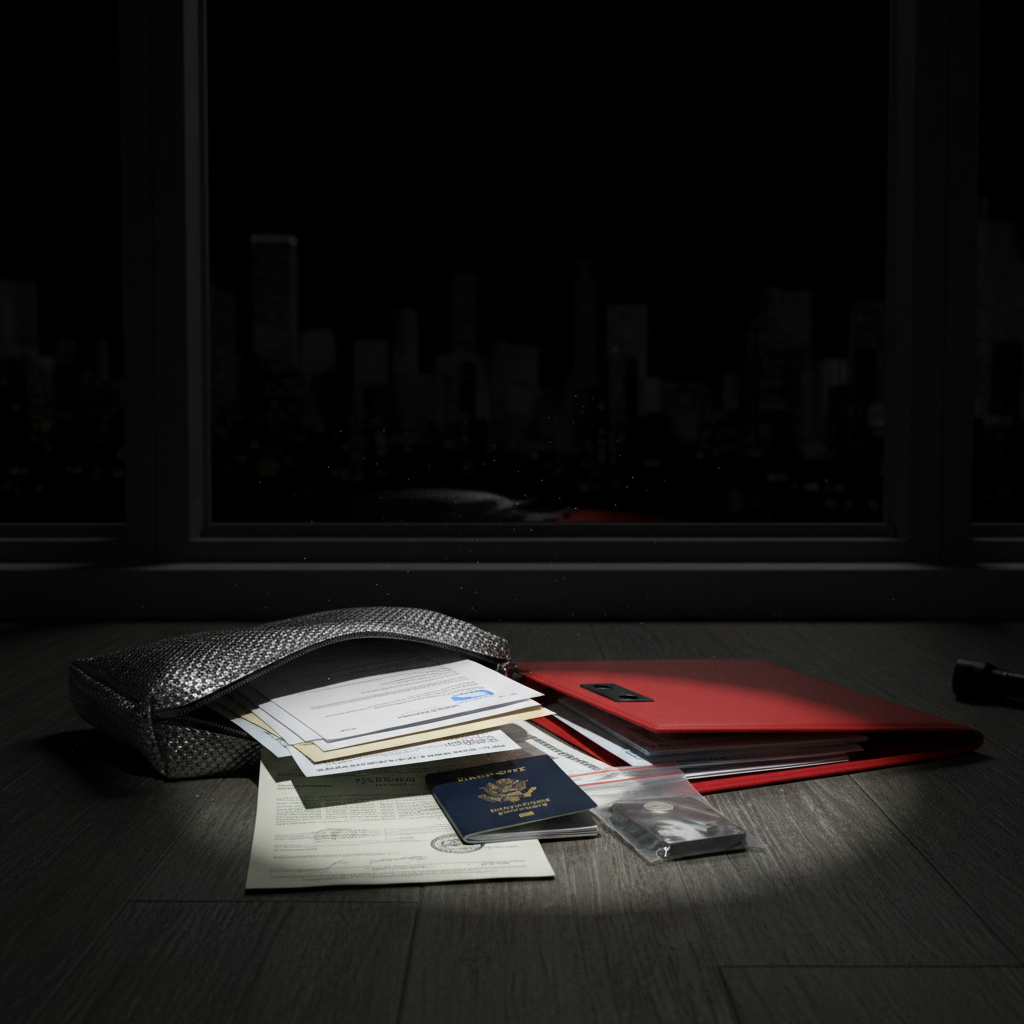
It's 2 AM. The fire alarm screams. Smoke is already curling under your door. You have maybe 90 seconds before the hallway is impassable. What do you grab?
Most people reach for their phone and wallet. Maybe a jacket. They leave behind the documents that prove who they are, what they own, and what they're entitled to — and spend the next 6 to 18 months paying for that decision. After a power outage or disaster, having your paperwork in order can mean the difference between a quick recovery and months of bureaucratic hell.
After Hurricane Katrina, FEMA reported that lack of identification was the single biggest barrier to receiving emergency assistance. The same pattern repeats in every major disaster — from the Texas winter storm to the Northeast blackout. Insurance claims get delayed without policy numbers. Banks freeze accounts they can't verify. Landlords won't lease to someone who can't prove income. The cascade effect of lost documents is brutal and slow.
This guide gives urban preppers a complete system: what documents to protect, how to store them, where to back them up digitally, how much emergency cash to keep, and how to execute a 2-minute evacuation drill that actually works in buildings with single stairwells and no garages. Pair this with your bug-out bag and 72-hour kit for complete readiness.
The Go-Bag File: What Goes In
Not every document deserves space in your grab-and-go kit. Focus on papers that are expensive or impossible to replace quickly and that you'll need within the first 72 hours of displacement.
Tier 1 — Identity & Residency (Grab First)
Identity Documents
- Driver's license or state ID (original)
- Passport (original — keep in the bag, not a drawer)
- Social Security card (photocopy — original stays in safe deposit)
- Birth certificate (certified copy)
- Immigration documents (green card, visa, work permit)
- Current signed lease agreement
- Renter's insurance declaration page
- Recent utility bill (proof of address)
Your lease and renter's insurance page are more important than most people realize. After a building fire, you'll need to prove where you lived, what your rent was, and what coverage you carry. Landlords aren't obligated to provide copies quickly — and insurance companies move at their own speed.
Tier 2 — Financial Access (Critical for Recovery)
Banking & Financial
- Bank account numbers + institution phone numbers
- Credit card numbers + issuer contact info
- Investment account statements (last quarter)
- Safe deposit box key + location
- Emergency cash — $500 minimum (denominations below)
Tier 3 — Medical & Insurance (Life-Saving)
Health & Coverage
- Health insurance cards (front and back photocopies)
- Current prescription list with dosages and pharmacy info
- Doctor contact information
- Immunization records
- Medical power of attorney / healthcare proxy
- Life insurance policy numbers
- Pet vaccination records + microchip numbers
Tier 4 — Employment & Legal (Recovery Phase)
Work & Legal
- Recent pay stubs or proof of income (2-3 months)
- Professional licenses or certifications
- Marriage certificate (if applicable)
- Will and power of attorney
- Vehicle title and registration
Physical Storage: The Two-Bag System
Your documents need three things: water protection, fire resistance, and instant access. Most people nail one. Almost nobody gets all three.
For urban preppers, I recommend a two-bag system. A fireproof document bag lives inside (or right next to) your main bug-out bag. If you need to abandon the larger bag, you can still grab the documents separately. They're your highest-value items per ounce.
ROLOWAY Fireproof Document Bag (Large)
Non-itchy silicone-coated fiberglass with a zipper closure and reflective strip. Fits letter-size documents without folding. The large size holds your full document kit plus a USB drive and emergency cash. Weighs 10 oz — negligible in a go-bag.
Some links below are affiliate links. As an Amazon Associate we earn from qualifying purchases, at no extra cost to you. We only recommend gear we’d actually use.
View on Amazon →SentrySafe CHW20221 Fire/Water Chest
If you want a permanent home base for originals (passports, birth certificates, insurance policies), this is the move. ETL-verified waterproof, 30 minutes of fire protection at 1550°F, and a key lock. Keep this in your closet with copies in the go-bag. Not portable enough for evacuation, but perfect for protecting originals from apartment fires.
View on Amazon →Inside Organization: The Ziploc Method
Use gallon-sized Ziploc freezer bags — one per category. Label each with a Sharpie: "IDs," "Financial," "Medical," "Insurance." This gives you double water protection and instant visual confirmation. In a panic, you see four labeled bags, not a chaotic stack of loose papers. You know immediately if one is missing.
The 3-2-1 Digital Backup Strategy
Physical documents burn, flood, and get stolen. Digital backups are your insurance policy for your insurance policy. Follow the 3-2-1 rule: 3 copies, 2 different media types, 1 copy offsite.
Copy 1: Encrypted USB Drive (In Your Go-Bag)
Scan every Tier 1-3 document at 300 DPI. Save as PDF. Store on a hardware-encrypted USB drive. This gives you access to everything even without internet — at a shelter, a relative's house, or standing in line at FEMA. Hardware encryption means a lost drive doesn't become identity theft.
Kingston IronKey Vault Privacy 50
Military-grade AES 256-bit encryption with a physical keypad. No software needed — works on any computer. Brute-force protection wipes the drive after 10 failed attempts. Overkill for most people, perfect for someone carrying their entire identity on a thumb drive.
View on Amazon →Copy 2: Encrypted Cloud Storage
Upload encrypted copies to a cloud service you trust. The key word is encrypted — don't just drop passport photos into Google Drive.
- Proton Drive — zero-knowledge encryption by default, free tier available
- iCloud with Advanced Data Protection — end-to-end encryption for Apple users
- Cryptomator + any cloud provider — free, open-source encryption layer that works with Dropbox, Google Drive, OneDrive
- Bitwarden Secure Notes — for account numbers and emergency contacts (already encrypted)
Copy 3: Physical Offsite
Photocopies in a sealed envelope at a trusted friend or family member's home, at least 10 miles away (outside your likely evacuation zone). A bank safe deposit box works too, but remember: banks close during disasters, and weekend access is limited. A person you trust is more reliable than an institution.
Emergency Cash: When ATMs Go Dark
During the 2003 Northeast blackout, 55 million people lost access to electronic payments simultaneously. Gas stations went cash-only. Grocery stores locked their doors. ATMs were dead. The people with cash in their pocket ate that night. Everyone else waited.
How Much and What Bills
Urban preppers without a vehicle: $500 minimum. With a car and potential evacuation: $1,000-2,000. Denomination mix matters — nobody makes change for a $100 bill during a crisis:
- $200 in $20s — general purchases, gas, hotels
- $100 in $10s — smaller buys, parking, tolls
- $100 in $5s — vending machines, exact change situations
- $100 in $1s — tips, small vendors, laundromats
| Denomination | Amount | Best Used For |
|---|---|---|
| $20s | $200 | General purchases, gas, hotels |
| $10s | $100 | Smaller buys, parking, tolls |
| $5s | $100 | Vending machines, exact change |
| $1s | $100 | Tips, small vendors, laundromats |
| Total | $500 | Minimum for urban preppers without a vehicle |
Store in a waterproof pouch inside your document bag. Not in your wallet — that's spending money. This is survival money. Refresh annually: damaged or suspicious-looking bills get rejected faster during crises when trust is low.
The 2-Minute Apartment Evacuation Drill
Most fire deaths in apartments aren't caused by flames. They're caused by hesitation. Going back for one more thing. Checking if the stove is off. Looking for the cat carrier. The antidote is rehearsal until the exit sequence is muscle memory.
The Sequence (Practice Monthly)
- Shoes on. Bare feet on broken glass, hot pavement, or debris-covered stairs end evacuations. Keep slip-on shoes by your bed.
- Grab the document bag. One motion from its hook by the door.
- Grab the go-bag (if time allows — document bag is priority).
- Touch the door. If it's hot, do not open it. Seal gaps with wet towels, go to a window, call 911.
- Take the stairs. Never the elevator. Count doors to the stairwell — in smoke, you won't see exit signs.
- Meet at your designated point.
Apartment-Specific Challenges
High-rise residents (7+ floors): Fire department ladders may not reach you. Early evacuation isn't optional — it's survival. Know both stairwells. If your primary is blocked by smoke, you need the secondary route memorized, not discovered. See our high-rise emergency prep guide for vertical evacuation strategies.
Stairwell re-entry doors: Many buildings lock stairwell doors from the stair side for security. If your exit stairwell is blocked at a lower floor, you may not be able to re-enter the building. Know which floors have re-entry access. Carry a flashlight — stairwells go pitch black when emergency lighting fails.
Single-stairwell buildings: If your only exit is compromised, your apartment becomes your shelter. Have a plan: seal the door, signal from a window, and wait for rescue. A whistle in your go-bag is worth more than a flashlight in this scenario. Consider door reinforcement and shelter-in-place supplies.
The Two Meeting Points
Agree on these with anyone in your household before an emergency:
- Point A (building-level): The parking lot, courtyard, or sidewalk across the street. For building-only incidents — fire alarms, gas leaks, structural issues.
- Point B (neighborhood-level): A landmark 5-10 blocks away — a church, gas station, park. For area-wide events where the building perimeter isn't safe.
The Home Inventory: 15 Minutes That Save Thousands
Insurance claims without documentation get lowballed. Claims with documentation get paid. The difference can be $5,000-20,000 on a renter's policy.
Walk through your apartment with your phone camera. Open every drawer, closet, and cabinet. Record a slow video narrating what you see: "Living room — 55-inch Samsung TV, IKEA Kallax shelf, MacBook Pro on the desk..." Save this video to your encrypted cloud storage. Update it quarterly or after major purchases.
For high-value items (electronics, jewelry, instruments), photograph serial numbers and receipts. Store these in the same encrypted folder as your document scans.
🔥 LEVEL UP YOUR PREP
Documents secured? These tools complete your evacuation readiness:
Ready America 72-Hour Deluxe Kit
72-hour kit for 2 people: food, water, first aid, light, and tools. The grab-and-go companion to your document bag.
View →Samsung T7 Shield Portable SSD
1TB encrypted, IP65 rugged, drop-resistant. Store your entire digital life — documents, photos, videos — in a device smaller than a credit card.
View →Grid-Down Survival Guide
Our 150+ page ebook covers documents, evacuation, power, food, water, security, and medical prep — the complete apartment survival system.
Get the Guide — $19.99 →FREE EVACUATION CHECKLIST
Get our complete document protection + evacuation checklist — plus urban preparedness tips delivered weekly.
No spam. Unsubscribe anytime.
As an Amazon Associate, Prepper.blog earns from qualifying purchases. We only recommend products we'd actually use. Prices and availability are accurate at time of publication.
📥 Free printable: Grab the Emergency Document Vault checklist — the full packing list for your document grab-bag. No email required.
Frequently Asked Questions
What documents should I have ready for emergency evacuation from my apartment?
The grab-and-go essentials: passport or ID, birth certificate, Social Security card, insurance policies, bank account info, property lease, medical records, and vaccination records. Store copies in a waterproof pouch inside your go-bag. Keep a second set with a trusted out-of-state contact.
How do I protect important documents during a disaster?
Use a waterproof fireproof document pouch for physical copies. Create encrypted digital backups stored in cloud storage AND on an offline USB drive. Keep a second copy of critical documents with a trusted out-of-state contact.
What is a 2-minute evacuation plan for apartment renters?
Pre-stage your go-bag near the door. Know two exit routes from your floor. Keep your document pouch and medication list inside the bag. Practice a timed walk to your vehicle or nearest transit. The goal: door closed and leaving in under 2 minutes with everything critical.
How much emergency cash should I keep at home?
Keep at least $500 in cash if you're an urban prepper without a vehicle, or $1,000 to $2,000 if you have a car and may evacuate. Use small denominations: $200 in $20s, $100 each in $10s, $5s, and $1s. Nobody makes change for a $100 bill during a crisis.
What is the 3-2-1 backup rule for important documents?
The 3-2-1 rule means keeping 3 copies of every critical document on 2 different media types with 1 copy stored offsite. In practice: scan documents at 300 DPI to a hardware-encrypted USB drive, upload encrypted copies to cloud storage, and leave physical photocopies with a trusted contact at least 10 miles away.
Why do I need my lease and insurance documents after a disaster?
After Hurricane Katrina, FEMA reported that lack of identification was the single biggest barrier to receiving emergency assistance. Your lease and renter's insurance declaration page prove where you lived, your rent, and your coverage. Documented insurance claims get paid; undocumented ones get lowballed, a difference of $5,000 to $20,000 on a renter's policy.
How do I store documents to survive both fire and flood?
Use a two-bag system. Keep originals in a UL-classified fire/water chest in your closet, and copies in a portable fireproof, waterproof document bag rated to around 2000°F inside your go-bag. Inside the bag, sort papers into labeled gallon Ziploc freezer bags by category for double water protection and instant visual confirmation.