Emergency Lighting for Urban Blackouts:
LED Lanterns, Headlamps & the Layered System
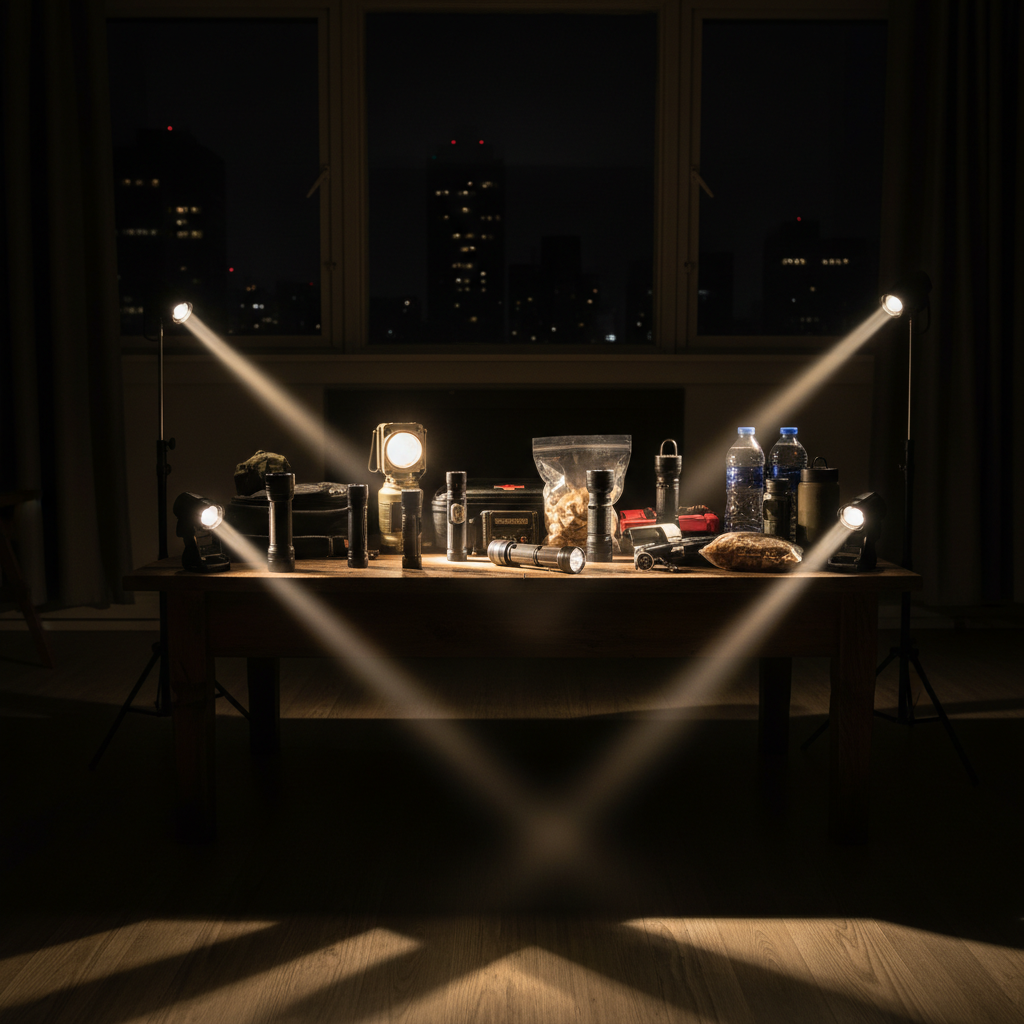
It's 9:47 PM. The lights flicker once, twice — then everything goes dark. Your phone is at 23%. You fumble for the flashlight app, knowing that battery won't last until morning. Now what?
Most urban preppers have never experienced a true extended blackout. When the Texas grid failed in 2021, some residents went 4+ days without power. During Hurricane Sandy, parts of Manhattan stayed dark for a week. Your phone's flashlight — and that half-used scented candle from 2019 — won't cut it.
This guide covers the lighting solutions that actually work for city apartments: what's safe for renters, what provides enough light to function by, and how to avoid the common mistakes that leave people stumbling around in the dark.
Why Your Phone Flashlight Is a Trap
Your phone flashlight seems bright — until you try to cook dinner, find medication, or navigate a dark stairwell with it. Here's the problem:
- Battery drain: The flashlight + screen kills a full charge in 4–5 hours. That's your only communication device, dead by morning.
- Harsh directional light: Phone LEDs create sharp shadows and zero ambient glow. You can see one spot but nothing around you.
- Overheating: Extended flashlight use causes phones to thermal throttle. Some will auto-dim or shut off entirely.
- Single point of failure: If your phone dies, you lose your light, your communication, and your alarm clock in one shot.
The real solution is a layered lighting system — multiple dedicated light sources for different tasks, all independent of wall power. Think of it like your food prep: you don't rely on a single can of beans. Same principle.
Layer 1: Area Lighting (Room-Level Glow)
You need at least one light source that fills an entire room. This is where you'll prepare food, play cards, read, and maintain some sense of normalcy. LED lanterns are the gold standard — efficient, safe, and surprisingly bright.
What Matters in a Blackout Lantern
- Runtime: 100+ hours on low mode — critical for multi-day outages
- Brightness settings: High for tasks (300+ lumens), low for ambient light that preserves battery and night vision
- 360° illumination: Lanterns beat flashlights because they light the whole room, not just one wall
- Hook or handle: Hang from cabinet handles, shower rods, or door frames to maximize coverage
- Power source: USB rechargeable (pair with a power bank) or standard D-cell batteries
Vont 4-Pack LED Camping Lanterns
The best value in emergency lighting. Military-grade construction, collapsible design for compact storage, lifetime warranty. At this price, you place one in every room — bedroom, bathroom, kitchen, entryway. Each runs on 3 AA batteries. No fumbling with a single lantern when nature calls at 3 AM.
Some links below are affiliate links. As an Amazon Associate we earn from qualifying purchases, at no extra cost to you. We only recommend gear we’d actually use.
View on Amazon →LuminAID PackLite Max 2-in-1
Inflatable, waterproof, and solar-powered. Charges in 12–14 hours of sunlight (or 1–2 hours via USB). Weighs almost nothing. Hang it in your window during the day, inflate it at night for a soft lantern glow. Originally designed for disaster relief — this is exactly what it's built for. Collapses flat for storage.
View on Amazon →Layer 2: Task Lighting (Hands-Free Work)
Lanterns light rooms. Headlamps let you work in those rooms. Cooking, patching a leak, administering first aid, navigating dark stairwells — all require both hands. A good headlamp is arguably more important than a lantern for actual survival tasks.
Headlamp Features That Matter
- Red light mode: Preserves night vision and won't blind others in close quarters
- Adjustable brightness: 200+ lumens for task work, 10 lumens for reading in bed
- Comfortable strap: You'll wear this for hours — cheap elastic headbands dig in and slip
- USB rechargeable: Charge from your power bank during the day, use all night
Black Diamond Spot 400-R Headlamp
Industry standard for reliability. Brightness memory (returns to your last setting), red/green/blue night vision modes, IPX8 waterproof, and a comfortable headband that doesn't slip during activity. The "R" version is USB rechargeable, saving you battery costs long-term. One charge lasts 200+ hours on low.
View on Amazon →Petzl Tactikka Core Headlamp
Hybrid power is the key feature: use the included rechargeable Core battery normally, then fall back to standard AAA in extended outages when you can't recharge. Wide beam pattern is better for close-up work (cooking, reading, first aid) than narrow spot beams. Red light mode is directly accessible without cycling through white modes first.
View on Amazon →Layer 3: Pocket Light (Always on You)
The power goes out when you're in the hallway, the stairwell, or the parking garage. You need a light that's always within arm's reach — small enough for a pocket, purse, or nightstand, bright enough to navigate safely.
Olight i3T EOS Pocket Flashlight
At this price, buy three: one for your nightstand, one for your jacket, one for your bag. Dual output (180 lumens high, 5 lumens low — low runs for 16 hours). Aircraft-grade aluminum body with a tail switch that's easy to find in total darkness. Simple, reliable, and the kind of thing that saves you from a broken ankle on dark stairs.
View on Amazon →The Red Light Advantage
Most quality headlamps and some lanterns include a red LED mode. There's a practical reason pilots, submariners, and military personnel use red light: it preserves night vision.
Your eyes take 20–30 minutes to fully adapt to darkness (rod photoreceptor activation). One blast of white light resets that clock completely. Red light doesn't trigger the same response — you can read, check on kids, or navigate your apartment without losing your ability to see in low light afterward.
Battery Strategy: The Hidden Key
Lights are useless without power. Your battery strategy matters as much as your light selection.
Primary: USB Rechargeable
Modern LEDs are incredibly efficient. A small Anker PowerCore 10000 (~$22) can recharge a headlamp 20+ times. Charge your lights during the day from a power station or power bank; use them at night. If you already have a portable power station (see our power station guide), you're set for weeks of lighting.
Secondary: Stockpile Batteries
Lithium batteries have a 10–15 year shelf life vs. 5–7 for alkaline, and perform better in temperature extremes. A 48-pack of Energizer Ultimate Lithium AA (~$35) is cheap insurance. Store batteries outside devices to prevent corrosion.
Tertiary: Solar Trickle Charging
A window-mounted or balcony solar panel can trickle-charge USB lights during the day. Slow, but infinite — critical for outages lasting more than a week.
Room-by-Room Positioning Plan
Don't just buy lights — position them strategically so you can find them in total darkness.
- Bedroom nightstand: Headlamp + pocket flashlight (your first grab when the power drops)
- Kitchen counter: Primary lantern, hung from a cabinet handle for maximum coverage
- Bathroom: Waterproof lantern (IPX4 minimum) — stumbling in a dark bathroom causes injuries
- Entryway/by the door: High-lumen flashlight for stairwell navigation and checking the hallway
- Living room: Second lantern. Bounce light off the ceiling for softer, wider coverage
- Light switches & door handles: Apply glow-in-the-dark tape strips ($8 for a roll) so you can find them without any light at all
Emergency Light Comparison: Specs at a Glance
How the recommended picks stack up across the three lighting layers — brightness, runtime, power source, and price:
| Light | Layer | Brightness | Runtime | Power | Price |
|---|---|---|---|---|---|
| Vont 4-Pack LED Lanterns | Area | 140 lumens each | 30+ hours | 3 AA batteries | ~$28 / 4 |
| LuminAID PackLite Max | Area | 150 lumens | — | Solar + USB | ~$30 |
| Black Diamond Spot 400-R | Task (headlamp) | 400 lumens | 200+ hrs on low | USB rechargeable | ~$65 |
| Petzl Tactikka Core | Task (headlamp) | 450 lumens | — | USB + AAA hybrid | ~$55 |
| Olight i3T EOS | 180 lumens (5 low) | 16 hrs on low | Single AAA | ~$20 |
The Complete Urban Blackout Lighting Kit
Here's the minimum effective setup for a one-bedroom apartment, total cost under $120:
- Vont 4-Pack Lanterns — one per room (~$28)
- Black Diamond Spot 400-R headlamp — hands-free task light (~$65)
- Olight i3T pocket flashlight — always-carry light (~$20)
- 48-pack lithium AA batteries — backup power for lanterns (~$35, optional if you have a power bank)
- Glow-in-the-dark tape — navigation in total dark (~$8)
That's 4 lanterns, 1 headlamp, 1 pocket light, and enough batteries for weeks of use. Total weight: under 3 lbs. Total storage: fits in a single drawer.
🔥 LEVEL UP YOUR PREP
Already have your lighting dialed? These upgrades turn a dark apartment into a comfortable basecamp:
EcoFlow River 2 Pro
768Wh power station — run LED lights for weeks. Also powers phones, laptops, and small appliances. Recharges via wall or solar.
View →Ready America 72-Hour Deluxe Kit
72-hour kit with food, water, light stick, and first aid for 2 people. The "I don't want to build my own kit" solution.
View →Grid-Down Survival Guide
Our 150+ page ebook covers lighting, power, food, water, security, and medical prep — everything you need in one place.
Get the Guide — $19.99 →FREE BLACKOUT PREP CHECKLIST
Get our complete urban preparedness checklist — lighting, food, water, power, and security — delivered to your inbox.
No spam. Unsubscribe anytime.
As an Amazon Associate, Prepper.blog earns from qualifying purchases. We only recommend products we'd actually use. Prices and availability are accurate at time of publication.
Frequently Asked Questions
What is the best emergency lighting for apartment blackouts?
Layer three types: (1) a 300+ lumen rechargeable LED lantern as the primary room light, (2) a headlamp for hands-free tasks and navigation, (3) a pocket flashlight kept always within reach for dark stairwells and hallways. Avoid candles as primary lighting — they are a fire risk in panicked conditions.
How long should emergency lights last during a power outage?
Quality LED lanterns run 20-100+ hours on a charge or set of batteries depending on brightness. Keep a minimum of 72 hours of lighting capacity per person. Recharge lanterns and power banks before a forecasted storm.
Are candles safe to use for lighting during an apartment blackout?
Candles are high risk in apartments — open flames near curtains, bedding, or in confined spaces cause fires, especially during stressful, dark conditions. Use battery-powered LED candles for ambiance. Reserve real candles as a last resort with extreme caution and never leave unattended.
How many lumens do I need for emergency lighting in an apartment?
For room-level area lighting, aim for 300+ lumens from an LED lantern to comfortably cook or read by, then drop to a low setting to save power. Task headlamps should hit 200+ lumens, while a 150–180 lumen pocket flashlight is enough to navigate dark stairwells safely.
Why use red light during a blackout instead of white light?
Red light preserves your night vision, which takes 20–30 minutes to fully develop as rod photoreceptors activate. A single blast of white light resets that adaptation entirely. Red LEDs don't trigger the same response and also draw less power, so you can read, check on kids, or move around without losing low-light awareness.
Are rechargeable or disposable batteries better for emergency lights?
Use USB-rechargeable lights as your primary system, since a small 10,000mAh power bank can recharge a headlamp 20+ times. Keep lithium disposables as backup: they hold a 10–15 year shelf life versus 5–7 for alkaline and perform better in temperature extremes. Hybrid headlamps that accept both give the most flexibility.
How do I find my flashlight in total darkness during a power outage?
Pre-position lights and mark them so you can locate them blind. Keep a headlamp and pocket flashlight on your nightstand as your first grab, hang lanterns from cabinet handles, and apply glow-in-the-dark tape (about $8 a roll) to light switches and door handles so you can find them with no light at all.