What Governments Are Telling Citizens to Prepare For (2026)
In the space of a few weeks, the UK launched a national "Be Ready" campaign, French regions re-issued 72-hour kit advice, and headlines started counting how many countries are telling their citizens to stockpile. Add reports of a Pentagon plan to keep military bases running for 90 days without outside help, and it is easy to conclude that governments know something the rest of us don't.
They mostly don't. What they are doing is converging on the same, fairly modest piece of advice. This page tracks what each government actually recommends, with links to the official sources, and turns it into one practical plan for a city household. We update it in place as guidance changes.
Quick answer: Almost every official campaign asks the same thing: be able to look after your household for about 72 hours without power, tap water, phone signal or card payments. That means stored water, no-cook food, a radio, light, a power bank, cash, medicines and a written plan. Governments describe this as routine resilience policy, not a warning of a specific attack, and fact-checkers have pushed back on "imminent catastrophe" readings (Snopes, Nov 3, 2026). Build the 72-hour kit first, then extend toward a week or two if you can.
Country by Country: What the Official Guidance Says
The headline number varies a little, but the shape of the advice is the same everywhere: water, food that doesn't need a fridge or cooker, a way to get information without the internet, light, cash, medicines, and a household plan.
| Country / bloc | Self-sufficiency target | Water guideline | Official source |
|---|---|---|---|
| United States | "Several days" (older material: 3 days) | 1 gallon (≈3.8 L) per person per day | Ready.gov (FEMA) |
| United Kingdom | 3 days (Be Ready, launched 22 Oct 2026) | 3 L per person per day for drinking, plus extra for cooking and washing | beready.campaign.gov.uk |
| European Union | Minimum 72 hours (guidance to member states) | Set by each member state | Preparedness Union Strategy (Mar 2025) |
| France | 72-hour kit | 6 L per person for the whole kit | SGDSN "Tous responsables" (Nov 2025) |
| Germany | 10 days recommended; 3 days as a minimum | About 2 L per person per day | BBK |
| Sweden | Roughly a week | At least 3 L per person per day | "In case of crisis or war" |
| Canada | At least 72 hours | 2 L per person per day | GetPrepared.ca |
| Australia | 3 days (state-led guidance) | 10 L per person for 3 days (Queensland) | Get Ready Queensland, Red Cross |
United States
US guidance hasn't changed much in two decades and wasn't part of the recent wave. Ready.gov, run by FEMA, asks households to keep enough to manage on their own for several days: one gallon of water per person per day (for drinking and sanitation), non-perishable food, a battery or hand-crank radio, a flashlight, a first-aid kit, a charged phone with a backup battery, and local maps. Older Ready.gov checklists put the figure at three days. In practice, most American blackouts, storms and boil-water notices fit inside that three-day window. The bigger gap for many city households is not the list but actually having it assembled.
United Kingdom: "Be Ready"
On 22 October 2026 the Cabinet Office launched Be Ready, the first stage of a three-year public campaign about coping with interruptions to electricity, water, phone and internet services. The official checklist asks for three days of bottled water (3 litres per person per day for drinking, plus more for cooking and washing), three days of non-perishable food, a battery or wind-up FM radio, a power bank, cash in case card payments or ATMs are down, printed copies of documents and phone numbers, and enough medication. A separate household emergency plan covers meeting points and shutting off utilities. Ministers said the campaign was not triggered by a specific or imminent threat (IBTimes UK); the launch itself focused on storms, wildfires and blackouts, with cyber threats entering the coverage afterwards.
European Union and France
In March 2025 the European Commission's Preparedness Union Strategy committed to guidelines for "population self-sufficiency of minimum 72 hours" (Euronews, Irish Times). It is guidance to member states, which set their own household advice. France followed with the SGDSN's "Tous responsables" guide in November 2025 and a 72-hour kit leaflet, recommending a grab-ready bag with water, food, a radio, a torch, medicines, a first-aid kit, cash and copies of ID, checked at least twice a year. It is a recommendation, with no penalty for not having one.
Germany, Sweden and the Nordics
The countries that have been at this longest ask for more than 72 hours. Germany's federal civil-protection office (BBK) recommends households be able to supply themselves for ten days, while noting that even three days helps, with drinking water (about 2 litres per person per day) as the first priority. Sweden mailed its updated brochure "In case of crisis or war" to households in November 2024 (The Local); it points households toward managing on their own for about a week, with at least 3 litres of water per person per day.
Canada and Australia
Canada's federal GetPrepared guide has asked for 72 hours of self-sufficiency for years, with 2 litres of water per person per day, a crank or battery radio, cash in small bills and copies of important papers. Australia's advice is mostly state-led: Get Ready Queensland suggests three days of food and 10 litres of water per person, and the Australian Red Cross publishes a free kit checklist and planning tools.
📌 Why the sudden attention? Most of this guidance is years old. What changed in late 2026 is that a large country (the UK) launched a national campaign, regional French authorities repeated their advice, and media round-ups started counting countries. The counting made routine advice look coordinated. The advice itself is the same 72-hour basics emergency managers have recommended for a long time.
What About Cyber Attacks?
Several of these campaigns mention cyber threats alongside storms and floods, and that is the part that frightens people most. It helps to look at the record.
The best-documented grid cyberattacks happened in Ukraine. In December 2015, attackers took control of three regional distribution utilities and cut power to roughly 225,000 customers for one to six hours (CISA alert). In December 2016, the Industroyer malware hit a Kyiv transmission substation and blacked out part of the city for about an hour (overview). In both cases operators restored power by switching to manual control. These were serious attacks by a capable state actor, and the outcome was hours of darkness, not months.
That doesn't make cyber risk trivial. A realistic cyber disruption is more likely to look like this:
- Payments stop working. Card terminals, tap-to-pay and ATMs depend on power and networks. Shops that stay open may be cash-only.
- Phones and data get unreliable. Cell towers have limited battery backup, and networks congest as everyone tries to call at once.
- Information gets noisy. Rumours spread faster than official updates. A radio tuned to local broadcasters is the most reliable source when apps fail.
- Specific services fail for days. Hospitals, pharmacies, fuel stations or a water utility may run on paper or reduced capacity while systems are restored.
The prep for that is exactly the 72-hour list: cash in small denominations, a battery or wind-up radio, a power bank, offline maps on your phone, phone numbers written on paper, and a backup way to reach family that doesn't depend on the cell network. For a deeper look at how outages cascade in cities, read What Really Happens When the Power Grid Fails. For the worst-case scenario people ask about, see EMP protection: what actually matters.
Project Fortress: The 90-Day Headline
In late October 2026, Fox News reported on a Pentagon initiative called FORTRESS to make major US military installations able to sustain essential operations, including electricity, water, fuel and communications, for about 90 days without outside support. Reporting describes microgrids that can disconnect from the civilian grid, large battery storage and, eventually, small nuclear reactors (Newsweek, The War Zone, Anadolu). Pentagon spokesman Sean Parnell made the case publicly, arguing that losing electricity means losing communications, water and logistics.
Read it with care. Accounts differ on how many installations are covered (reports range from roughly 200 to about 500 sites), whether the plan was announced or leaked, and how firm the 90-day figure is; The War Zone noted it was unclear whether officials explicitly confirmed it. We found no published timeline. Analysts also point out that batteries and microgrids cover hours to days, and 90 days requires on-site fuel or reactors that are years away.
⚖️ The realistic middle ground: The military plans for 90 days because its job is to keep fighting through the worst case. Your government asks you for 72 hours because that covers the vast majority of real emergencies. For a city household, a sensible target sits between the two: a complete 72-hour kit now, then water and food extended to one to two weeks as space and budget allow. That's roughly where Germany and Sweden already set their advice.
The 72-Hour Plan for a City Household
Here is the overlap of the official lists, in the order we'd buy them. Most of it fits in a closet. For the full space-saving version, see our 72-Hour Urban Blackout Kit.
- Water first. At least 3 days at about a gallon (roughly 4 litres) per person per day for drinking and basic hygiene. Small apartment? See water storage without a basement and our water storage calculator.
- No-cook food. Three days of shelf-stable food you'll actually eat, plus a manual can opener.
- Information without the internet. A battery or wind-up FM radio. Set up emergency alerts on your phone while things are normal.
- Light and power. A headlamp or torch with spare batteries, and a charged power bank for each phone.
- Cash and paper. Small notes, plus printed copies of IDs, insurance details and key phone numbers. See backing up important documents.
- Medicine and first aid. A first-aid kit and several days of essential medicines; order repeat prescriptions before you run low. See emergency medication prep.
- A household plan. A meeting point, a backup way to reach each other, how to shut off water and electricity, and who checks on vulnerable neighbours.
📥 Free printable: The 3-Day Blackout Checklist puts the first 72 hours on one page. For the full list, use the Urban Preparedness Checklist.
What This Doesn't Mean
It doesn't mean governments expect a specific attack on a specific date, and it doesn't mean you need to empty supermarket shelves. The Be Ready launch was followed by reports of panic buying in the UK (Bastille Post), which is exactly what the campaign did not ask for. Buying a little extra each shop builds the same kit without the rush. It also doesn't mean 72 hours is a magic number. It is a floor that covers most blackouts, storms and outages, and the easiest one to reach.
We'll keep this page updated as governments publish new guidance. If your country's advice changes, the table above is where you'll see it first.
FieldScout
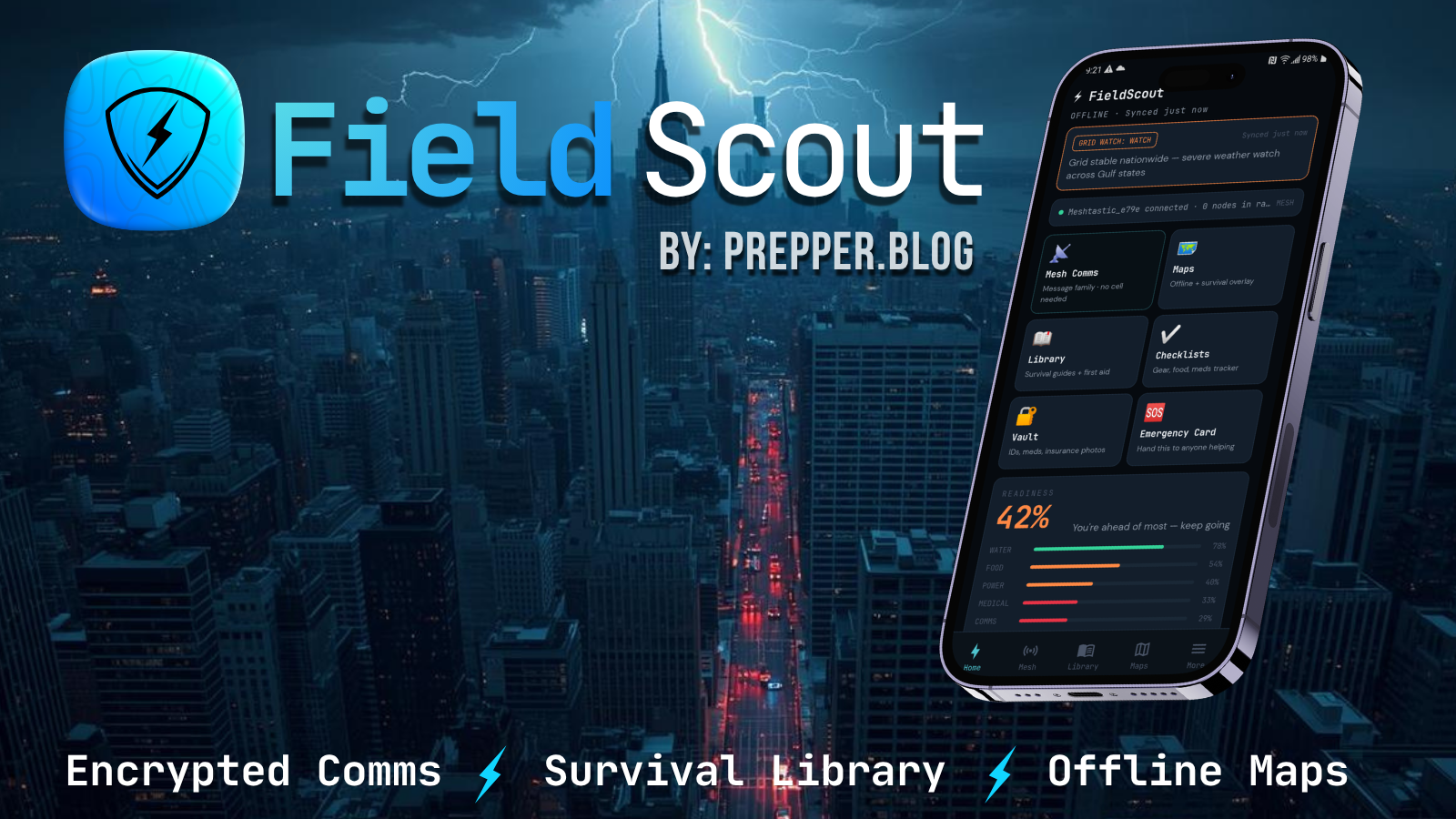
The best prep guidance is the kind that is still readable when the grid and cell network are not. FieldScout is our free offline app — the latest grid and weather status synced to your pocket, plus offline maps, survival checklists, an encrypted document vault, and mesh-radio comms that keep working with no internet and no cell service.
GET FIELDSCOUT FREE →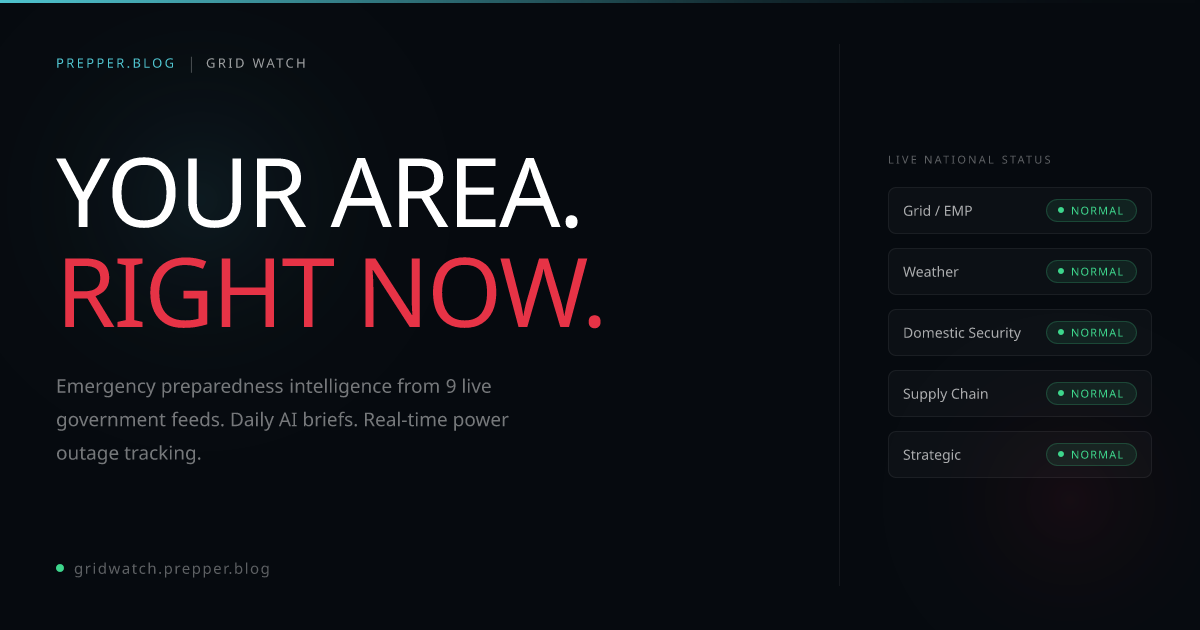
GridWatch
Preparedness is easier when you are not surprised — one daily brief covers the threats actually developing. GridWatch monitors live federal feeds — NOAA, FEMA, USGS, NERC, CISA — around the clock, tracks power outages in real time, and sends one plain-English daily brief so you hear a developing threat before it reaches your block.
SEE TODAY'S STATUS →KEEP WORKING WHEN THE NETWORK DOESN'T
Two tools we built for exactly the gaps the official lists point at: information and navigation when phones and the internet are unreliable.
FieldScout
Offline maps with hospitals, pharmacies and water sources, a survival library and checklists that work in airplane mode, and text messaging over MeshCore mesh radios when the cell network is down.
GET FIELDSCOUT →Grid Watch
One local threat score per US ZIP built from government data sources: grid stress, weather alerts, wildfires, outages. Quiet when nothing is happening.
CHECK YOUR ZIP →3-Day Blackout Checklist
The first 72 hours on one page, mapped to the same items the official lists ask for.
DOWNLOAD FREE →Frequently Asked Questions
Why are so many governments telling people to stockpile supplies right now?
Because household resilience has become standard civil-protection policy. The EU set a 72-hour self-sufficiency goal in its March 2025 Preparedness Union Strategy, France published a national 72-hour kit guide in November 2025, and the UK launched its three-year Be Ready campaign on 22 October 2026. UK ministers said the campaign was not prompted by a specific or imminent threat. The advice is about storms, floods, wildfires, blackouts and outages of phone, water and internet services, not a countdown to a single event.
Is a 72-hour emergency kit enough?
For most urban emergencies, 72 hours covers the gap between an outage starting and organised help or restored services arriving. It is a floor, not a ceiling. Germany recommends 10 days of supplies and Sweden's brochure points households toward roughly a week. A sensible path is to build a solid 72-hour kit first, then extend water and food toward one to two weeks as space and budget allow.
What should be in a 72-hour emergency kit?
The official lists overlap heavily: drinking water (roughly 2 to 4 litres or 1 gallon per person per day), non-perishable food that needs no cooking, a battery or wind-up radio, a torch or headlamp with spare batteries, a charged power bank, cash in small notes, a first-aid kit and at least a few days of essential medicines, printed copies of key documents and phone numbers, hygiene supplies, and supplies for babies or pets if you have them.
What is Project Fortress?
FORTRESS is a reported Pentagon initiative to make major US military installations able to keep operating for about 90 days without outside support, using microgrids, large-scale battery storage and, eventually, small reactors. It was widely covered in late October 2026 following a Fox News report. Coverage disagrees on details such as how many bases are covered and how firm the 90-day target is, and we found no published timeline. It is a plan to harden military bases, not a public warning to households.
Can a cyberattack take down the power grid?
It has happened, but the real-world record is outages of hours, not months. The December 2015 attack on Ukrainian distribution utilities cut power to roughly 225,000 customers for one to six hours, and the December 2016 Kyiv substation attack caused an outage of about an hour. Operators restored power by switching to manual control. A cyber incident is more likely to disrupt payments, phone networks or specific services for a few days than to cause a permanent blackout.
Why do governments tell people to keep cash at home?
Card terminals, ATMs and online banking all depend on electricity and networks. In a regional power cut or a cyber incident affecting payment systems, cash may be the only way to buy food or fuel for a few days. The UK Be Ready checklist and Canada's kit list both include cash, ideally in small denominations.
Do I need to buy an official government survival kit?
No. None of the governments covered here sells or endorses a commercial kit, so be wary of products marketed as the official government kit. Most of the items are already in your home. Build your kit gradually from the official checklists and spend money first on water storage, a radio, a power bank and any medicines you depend on.