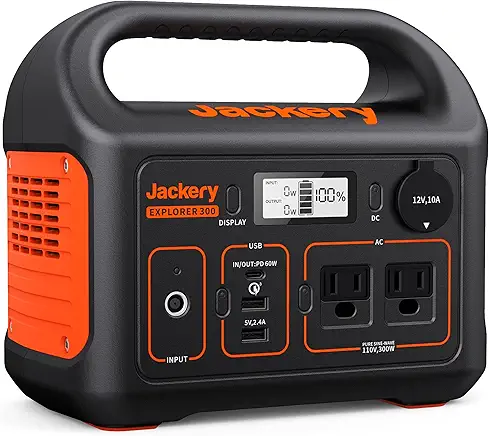
- Watt-hours, not marketing names. Capacity in Wh is what decides runtime. Realistic runtime ≈ Wh × 0.85 ÷ device watts — about 4–8 hours of a 30–60W CPAP from a ~300Wh unit.
- Pure sine wave AC. CPAPs, laptop chargers and anything with a motor run cooler and quieter on pure sine wave output. All current Jackery Explorers are pure sine wave.
- Continuous vs. surge watts. The 300W rating is continuous. Anything with a heating element — kettles, hair dryers, space heaters — is out of reach for this size class.
- Recharge options. Wall, car and solar input. In a multi-day outage, solar input is what turns a battery into a renewable supply.
Can a 300Wh power station run a refrigerator?
Only briefly. A full-size fridge uses roughly 1–2 kWh a day, so a ~300Wh unit covers a few hours at best, and the compressor startup surge can exceed a 300W inverter. Keep the fridge closed and save the station for phones, lights, fans and medical devices.
Is it safe to use a power station indoors?
Yes — unlike a gas generator, a battery power station produces no carbon monoxide, which is why it is the realistic backup for apartments and condos.
How often should I charge it in storage?
Top it up every 3 months and store it around room temperature. Lithium batteries slowly self-discharge, and a station found at 20% on day one of an outage is half a tool.
Complete Your Prep Kit
A power station paired with solar is your apartment generator. See the full setup in our guides.
Browse Survival Guides →Want the full context — what to buy, what to skip, and how this fits an apartment setup? Read the complete guide: Best Portable Power Stations for Urban Blackouts (2026).