President Trump made a statement recently that should have stopped everyone cold: "We could take apart their electric capacity within 1 hour, and it would take them 25 years to rebuild. So ideally, we're not going to be doing that."
He was talking about Iran. But here's what nobody's saying out loud: the same vulnerability exists here. And it wouldn't take a military strike to trigger it.
The Machines Nobody Talks About
Meet the Large Power Transformer (LPT) — the most critical piece of infrastructure you've never thought about. These aren't the gray boxes humming on utility poles in your neighborhood. LPTs are industrial giants: up to 400 tons, two stories tall, custom-built for specific grid locations. Moving one requires specialized rail cars, route planning that takes months, and coordination with dozens of agencies.
There are roughly 2,100 LPTs across the United States. Together, they form the spine of our electrical grid, stepping voltage up for long-distance transmission and down for local distribution. Without them, power generated at plants never reaches cities.
Here's the problem: we can't replace them quickly. Not even close.
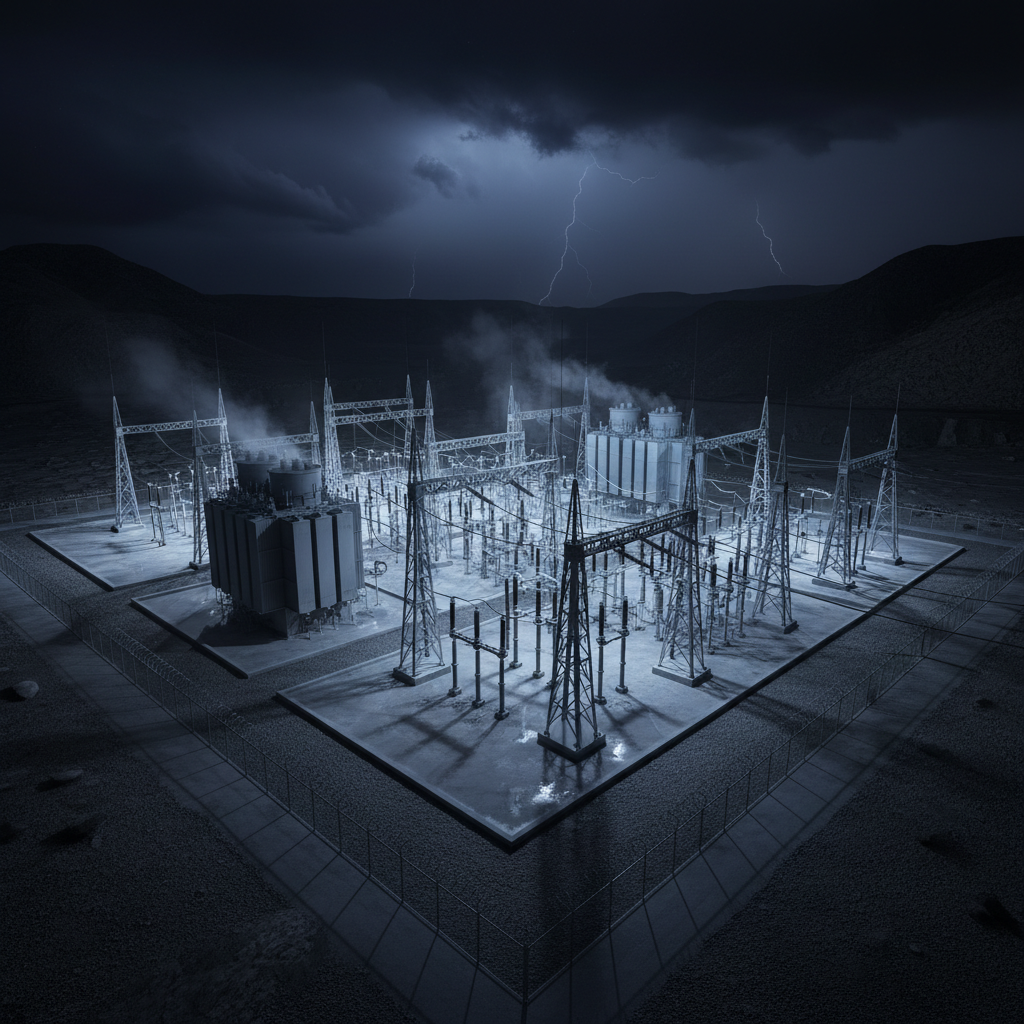
A high-voltage transmission substation. Facilities like this house the Large Power Transformers that move electricity across entire regions — and they sit largely unguarded.
The Math That Should Worry You
A single LPT takes over two years to manufacture from order to delivery. They're built case-by-case to exacting specifications — no two are identical. The specialized steel cores, copper windings, and cooling systems come from a shrinking pool of global suppliers, many subject to trade restrictions and supply chain bottlenecks.
Current industry estimates put the backlog at 3–4 years and climbing. Global demand is surging as aging grids worldwide face the same replacement cycle simultaneously. Component scarcity, tariffs, and geopolitical friction have turned what was already a slow process into a potential crisis.
The cost to harden or replace all vulnerable LPTs? Tens of billions — eleven figures. Even at that price, manufacturing capacity doesn't exist to execute quickly.
Four Ways This Actually Happens
That was one substation. Multiply it.
Cyberattack: Foreign actors have mapped our grid for years. The 2015 Ukraine blackout — engineered by Russian hackers — proved software can do what bombs used to. U.S. utilities report thousands of probes monthly.
Physical attack: Substations sit in remote locations, often fenced but unguarded. Critical nodes are publicly listed on federal registries. The knowledge required to disable one fits in a single document.
Natural disaster: Hurricane Maria destroyed transformers across Puerto Rico. Replacement took eleven months because the units couldn't be sourced faster. Ice storms, earthquakes, and flooding all pose similar risks.
EMP: Solar coronal mass ejections have caused grid failures before. A coordinated electromagnetic pulse — solar or man-made — could fry transformer windings across entire regions simultaneously.
What Urban Preppers Actually Need to Know
If you live in a city, you're not hardening a homestead. You're managing different constraints: apartment storage, no generators, dependence on complex supply chains that require refrigeration and communications.
The LPT vulnerability matters because it determines duration. A standard blackout — downed lines, localized equipment failure — lasts hours or days. An LPT failure in the wrong location extends that to weeks or months. When critical transmission nodes fail, utilities can't route around the damage. The power simply has nowhere to go.
This isn't theoretical. Texas in 2021 showed how quickly a strained grid collapses when generation and demand misalign. Now imagine the same scenario without the ability to import power from neighboring states because the transformers connecting those markets are offline.
The When, Not If
No serious grid security analyst disputes the vulnerability. Government reports going back fifteen years have flagged LPT replacement capacity as a strategic weakness. Industry executives acknowledge the problem privately while noting publicly that they're doing what they can with available resources.
The question isn't whether a major grid failure happens. It's which trigger — cyber, physical, natural, or electromagnetic — reaches the threshold first.
For urban preppers, this reframes preparation. Short-term outage kits are necessary but insufficient. The realistic planning horizon for a cascading LPT failure isn't 72 hours. It's 72 hours to several weeks, potentially longer depending on your region's spare inventory and manufacturing priority.