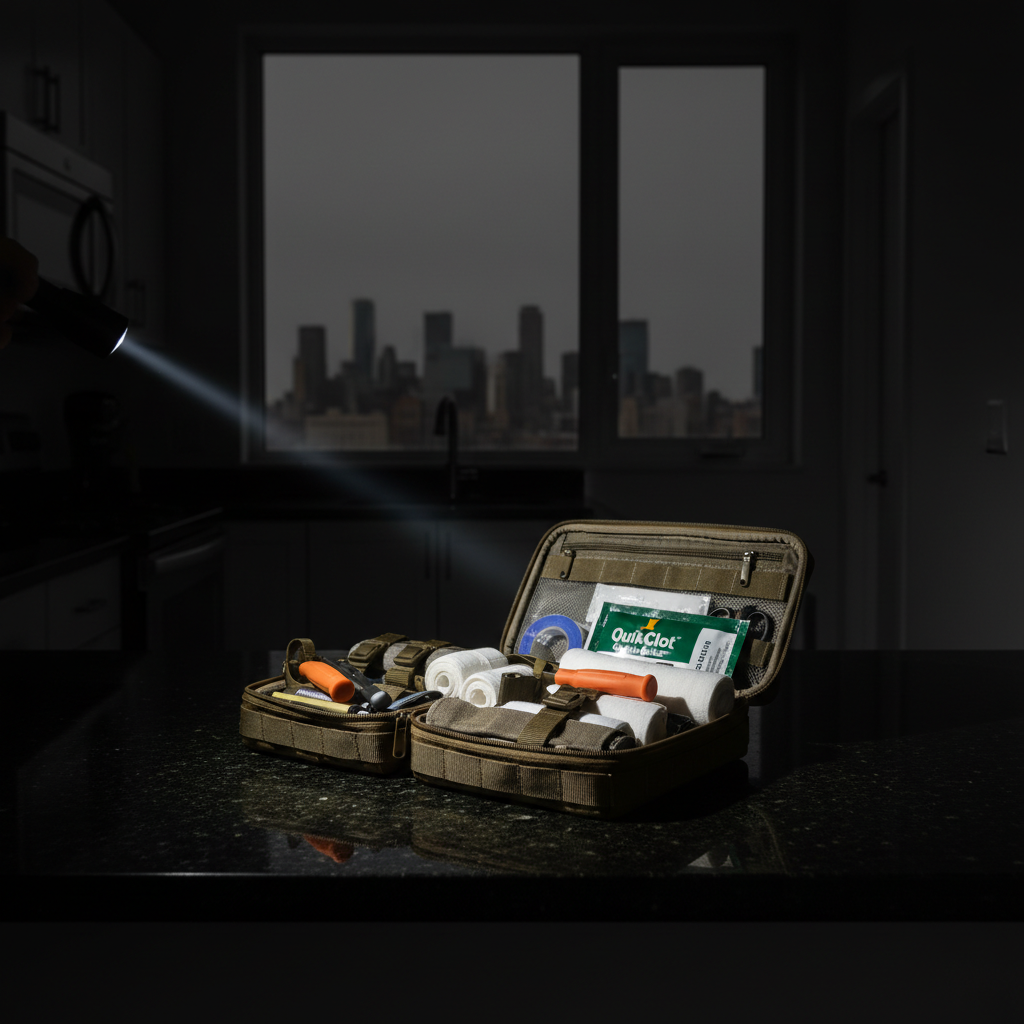
During Hurricane Maria, 911 response times in San Juan stretched to 12+ hours. After the 2021 Texas freeze, ambulances couldn't navigate iced-over roads for days. And when the next grid failure hits your city, those same delays will apply to your apartment building.
Here's the uncomfortable truth: in a prolonged blackout, you are the first responder. That kitchen knife slip while cooking by flashlight. Your elderly neighbor's chest pain. Your kid choking on emergency rations eaten too fast in the dark. Professional help might be coming—but not fast enough.
Having a first aid kit is step one. Knowing how to actually use it is the part that saves lives. These five skills cover the emergencies most likely to happen in an apartment during a grid-down scenario—taught in plain language, with zero medical training assumed.
⚠️ IMPORTANT DISCLAIMER
This guide is educational, not medical advice. Always call 911 first if phones work. These techniques bridge the gap until professional help arrives—they don't replace it. Take a certified first aid/CPR course from the American Red Cross or American Heart Association.
Skill #1: Stop the Bleed — The 5-Minute Window
Severe bleeding kills faster than almost anything else—a person can bleed to death in under five minutes. It's the #1 preventable cause of death from traumatic injury, according to the American College of Surgeons. During blackouts, the risk spikes: people trip in the dark, cut themselves cooking with unfamiliar tools, or injure themselves on broken glass from storm damage.
Recognize Life-Threatening Bleeding
- Blood that spurts rhythmically (arterial) or flows continuously
- Blood pooling on the ground or soaking through clothing
- Victim appears pale, clammy, confused, or dizzy (shock)
- A wound that won't stop oozing after a few minutes of pressure
The Three Techniques (Use in Order)
1. Direct Pressure — Your First Move
- Expose the wound (tear/cut clothing if needed)
- Apply firm, steady pressure with both hands using gauze or clean cloth
- Push hard—this will hurt the victim, and that's okay
- Hold for a full 10 minutes without peeking
- If blood soaks through, add more material on top—never remove saturated layers
2. Wound Packing — For Deep or Gaping Wounds
- Use hemostatic gauze (QuikClot Combat Gauze) or regular sterile gauze
- Pack the gauze into the wound cavity, not just on top
- Fill tightly, then apply direct pressure on top
- Hold 3 minutes (hemostatic) or 10 minutes (regular gauze)
3. Tourniquet — Limbs Only, Last Resort
- Place 2-3 inches above the wound (not over a joint)
- Tighten until bleeding stops completely
- Write the time on the victim's skin with a marker
- Do not remove until EMS takes over
🏠 APARTMENT TIP
Keep a bleeding control kit near your kitchen—the most common injury site in any home. A QuikClot pack, gauze, and a CAT tourniquet take up less space than a coffee mug.
Skill #2: Hands-Only CPR — When Every Second Counts
Cardiac arrest survival drops 7-10% every minute without CPR. In a normal scenario, EMS arrives in 8-12 minutes. During a blackout? Could be 30 minutes. Could be hours. The math is brutal—but hands-only CPR changes it dramatically.
The good news: the American Heart Association now recommends hands-only CPR (no mouth-to-mouth) for untrained bystanders. It's simpler, less intimidating, and nearly as effective in the first critical minutes.
How to Recognize Cardiac Arrest
- Person collapses or is found unresponsive
- Shake their shoulders and shout—no response
- No normal breathing (gasping doesn't count)
The Steps
- Call 911 (or send someone) — put on speakerphone
- Place victim flat on their back on the hardest surface available (floor, not bed)
- Hand position: Heel of one hand on center of chest (lower sternum). Other hand on top, fingers interlocked. Arms straight, elbows locked
- Push hard and fast: At least 2 inches deep, 100-120 compressions per minute
- Let the chest fully recoil between each compression
- Don't stop until EMS arrives, the person starts breathing, or you physically can't continue
Rhythm hack: Push to the beat of "Stayin' Alive" by the Bee Gees (100 BPM). It's not a joke—the AHA actually recommends it.
🏢 HIGH-RISE REALITY CHECK
In a building with no elevator power, EMS has to climb stairs carrying equipment. Every floor adds minutes. On the 15th floor during a blackout, your hands-only CPR might need to last 20+ minutes. Recruit a neighbor to trade off every 2 minutes—quality compressions are exhausting.
Skill #3: Choking Response — The 5-and-5 Method
Choking risk increases during emergencies. People eat unfamiliar foods, eat stressed and too fast, and dim lighting makes it harder to see what you're putting in your mouth. If you have kids eating emergency rations by flashlight, the risk multiplies.
Recognizing Severe Choking
- Cannot cough, speak, or make sound
- Universal choking sign: hands clutching throat
- Skin turning blue around lips and fingertips
- Wide-eyed panic, silent gasping
If they can cough forcefully, encourage them to keep coughing—don't intervene yet.
For Conscious Adults and Children Over 1
- 5 Back Blows: Stand behind and slightly to the side. Deliver firm strikes between the shoulder blades with the heel of your hand
- 5 Abdominal Thrusts (Heimlich): Stand behind them, wrap arms around their waist. Make a fist just above the navel, grasp with other hand, and pull sharply inward and upward
- Alternate sets of 5 until the object dislodges or the person goes unconscious
If They Go Unconscious
- Lower them to the ground carefully
- Call 911
- Begin CPR—check the mouth for visible objects before each breath attempt
If You're Alone and Choking
Make a fist above your navel. Thrust yourself against the back of a chair, countertop edge, or table corner. Hard, sharp thrusts—don't be gentle with yourself.
Skill #4: Burn Treatment — Blackout Cooking Gone Wrong
Candles, camp stoves, propane burners, improvised cooking setups—blackout cooking is burn territory. Add in kids, unfamiliar equipment, and poor lighting, and burns become one of the most common blackout injuries. Knowing the difference between "run it under water" and "call 911 now" matters.
Burn Classification
- First-degree: Red, painful, no blisters. Think mild sunburn. Treat at home
- Second-degree: Blisters, intense pain, red/white splotchy skin. Treat carefully at home if small
- Third-degree: White, charred, or leathery skin. May be painless (nerve damage). Always needs professional care
Immediate Treatment (First and Second Degree)
- Cool the burn under cool (not cold) running water for 10-20 minutes. If water is unavailable, use a cool wet cloth
- Remove constricting items (rings, watches, bracelets) before swelling starts
- Cover loosely with sterile non-stick gauze or clean plastic wrap
- Never apply butter, oil, toothpaste, or ice
- Never pop blisters—they're nature's bandage
- Pain relief: Ibuprofen or acetaminophen from your medical prep kit
🚨 CALL 911 FOR BURNS THAT ARE:
Third-degree (white/charred), larger than the victim's palm, on face/hands/feet/genitals/joints, caused by chemicals or electricity, or accompanied by breathing difficulty. When in doubt, treat it as serious.
Skill #5: Fracture and Sprain Stabilization
Dark hallways, unlit stairwells, cluttered apartments, emergency evacuations—falls spike during blackouts. A twisted ankle might just slow you down. A broken bone handled wrong can cause permanent damage, nerve injury, or dangerous internal bleeding.
Is It Broken or Sprained?
Honestly? Without an X-ray, assume the worst and treat it as a fracture. But these clues help:
- Fracture signs: Visible deformity, immediate severe swelling, inability to bear any weight, grinding sensation, bone visible through skin
- Sprain signs: Swelling develops gradually, can still bear some weight (painfully), no obvious deformity
The RICE Protocol
- Rest: Stop all activity on the injured area immediately
- Ice: 20 minutes on, 20 minutes off. Wrap ice in cloth—never directly on skin. No ice? A bag of frozen vegetables works
- Compression: Wrap with an elastic bandage—snug, not tight. If fingers/toes go numb or blue, loosen it
- Elevation: Raise the injury above heart level to reduce swelling
Improvised Splinting
If you suspect a fracture, immobilize the limb before moving the person:
- Splint material: Rolled magazines, cardboard, wooden spoons, rulers—anything rigid
- Padding: Towels, clothing, pillows between splint and skin
- Secure: Use tape, strips of cloth, or belt—above and below the injury
- Rule: Splint the joint above AND below the fracture
- Never try to straighten a deformed limb—splint it in the position you found it
🦴 OPEN FRACTURE (BONE VISIBLE)
Cover the wound with a moist sterile dressing. Do NOT push the bone back in. Control bleeding with gentle pressure around (not on) the wound. Call 911—this is a surgical emergency regardless of grid status.
Your Apartment First Aid Kit — Essentials for All 5 Skills
The best training is useless without supplies. Here's what covers all five skills above, organized by priority:
Swiss Safe 200-Piece First Aid Kit
Covers basics for all 5 skills: gauze, bandages, splint material, burn dressings, CPR face shield. Fits in a drawer.
View on Amazon →QuikClot Hemostatic Gauze
Military-grade bleeding control. Clots wounds 3x faster than regular gauze. Essential for Skill #1.
View on Amazon →CAT Tourniquet (Gen 7)
The same tourniquet used by US military and first responders. One-handed application. Can save a life in 30 seconds.
View on Amazon →Surviveware Large First Aid Kit
600+ pieces including trauma shears, splints, burn gel, and labeled compartments. For serious preppers.
View on Amazon →🎯 LEVEL UP YOUR MEDICAL PREP
Basic first aid supplies handle 80% of emergencies. These additions handle the other 20%—the situations where preparation is the difference between a scary night and a tragedy.
Sustain Supply Emergency Kit
Complete 72-hour kit for 4 people. Includes first aid, lighting, and food—one purchase covers multiple preparedness gaps.
View on Amazon →Surviveware Trauma First Aid Kit
Goes beyond basic: includes chest seals, Israeli bandage, SAM splint, NPA airway. Serious gear for serious situations.
View on Amazon →Grid-Down Survival Guide
Our 182-page guide covers first aid, medical prep, and 60+ other topics for apartment dwellers. Digital—always accessible.
Learn More →Get the Full Medical Prep Checklist Free
Join thousands of urban preppers getting weekly guides, checklists, and survival tips delivered to their inbox.
GET FREE RESOURCES →