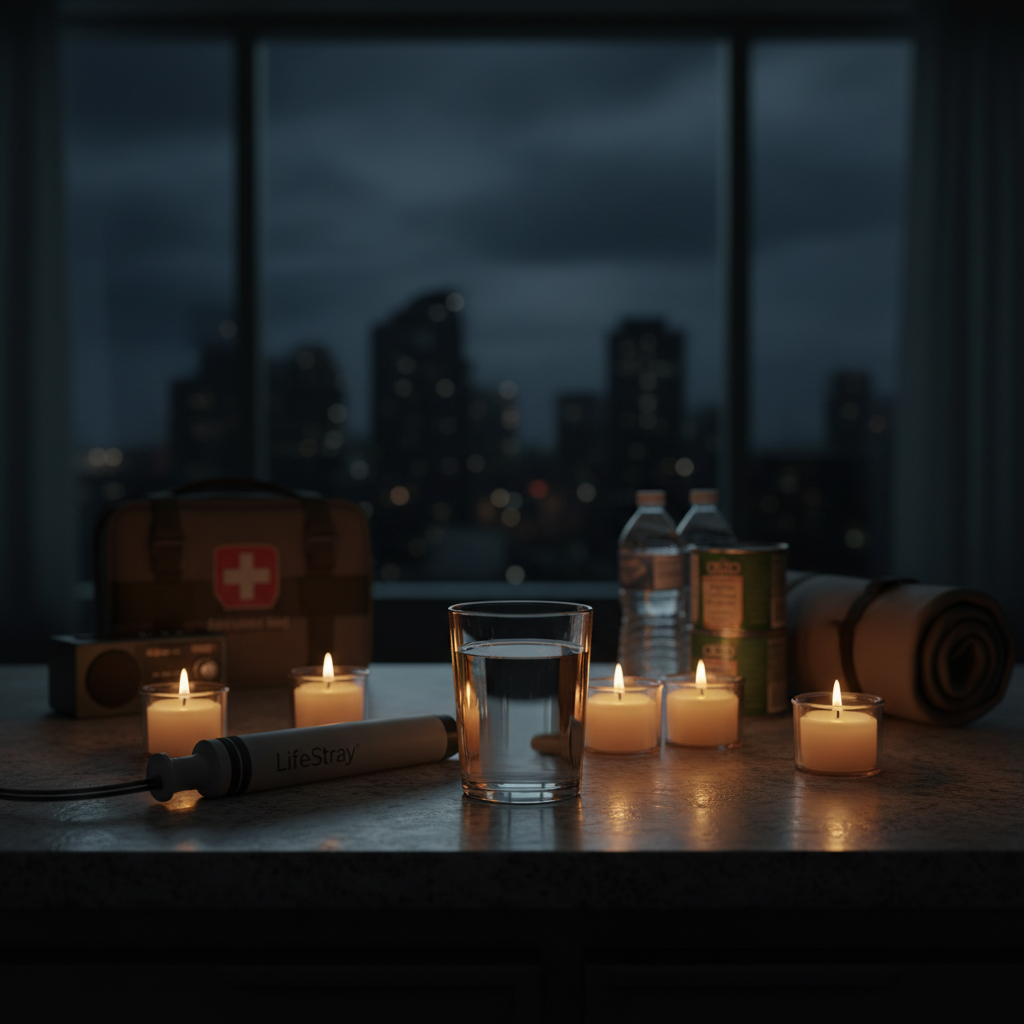
You've stockpiled your 14-day water supply. Smart. But what happens when day 15 arrives and the taps are still dry? In a prolonged blackout, water treatment plants stop working. Pressure drops in the lines. Contaminants seep into compromised pipes. That "clear" water from your bathtub or balcony collection might harbor bacteria, viruses, parasites, or chemical pollutants.
Water storage gets you through the first crisis. Water purification keeps you alive after that. This guide covers the 3-tier filtration system every apartment prepper needs: portable personal filters for on-the-go, gravity systems for base camp, and chemical backup when filtration isn't enough.
Critical Stat
Waterborne diseases kill more people annually than all forms of violence combined—including wars. In a grid-down scenario, municipal water contamination becomes a matter of when, not if.
Tier 1: Personal Straw Filters — Your EDC Lifeline
Personal straw filters are the pocket knives of water purification: small enough to carry everywhere, capable of filtering thousands of gallons, and requiring zero setup. For apartment dwellers who might need to evacuate or collect water from rooftop tanks, nearby streams, or questionable municipal sources, these are non-negotiable.
The gold standard is the LifeStraw Personal Water Filter. It removes 99.999999% of bacteria and 99.999% of parasites—no pumping, no waiting, no chemicals. Just stick it in the water and sip. At 2 ounces and the size of a fat marker, it fits in any go-bag, glove box, or jacket pocket. Each unit filters 4,000 liters—enough for one person for over 3 years of daily use.
LifeStraw Personal Water Filter
Removes 99.999999% of bacteria, 99.999% of parasites. 4,000-liter capacity. Weighs 2 oz. No batteries, no pumping, no waiting.
View on Amazon →For a more versatile option, the Sawyer MINI Water Filtration System offers similar protection with added flexibility. Attach it to the included squeeze pouch, screw it onto standard disposable bottles, or use it as a straw directly from the source. The MINI filters up to 100,000 gallons—effectively a lifetime supply for one person—and can be backflushed to restore flow rate when it slows.
Sawyer MINI Water Filtration System
100,000-gallon capacity. 0.1 micron absolute filtration. Fits in the palm of your hand. Includes squeeze pouch, straw, and cleaning plunger.
View on Amazon →Pro tip: Buy multiples. Keep one in your bug-out bag, one in your kitchen drawer, and one in your vehicle. At under $25 each, redundancy is affordable insurance.
Tier 2: Gravity Systems — Base Camp Water Station
When you're sheltering in place and need to process larger volumes for cooking, hygiene, and drinking, pumping water through a straw filter gets old fast. Enter gravity filtration: fill the dirty bag, hang it up, and let physics do the work.
The LifeStraw Peak Series Gravity Water Filter System is purpose-built for apartment scenarios. The 3L reservoir hangs from a curtain rod, closet rod, or shower head. Contaminated water goes in the top; clean water flows from the bottom—no pumping, no batteries, no moving parts to break. The integrated carbon filter reduces chemicals, pesticides, and improves taste, which matters when you're drinking stored bathtub water that tastes like chlorine and regret.
LifeStraw Peak Series Gravity System (3L)
3-liter capacity. Hang-and-filter simplicity. Carbon filter improves taste. Processes 1 liter in ~3 minutes. Folds flat for storage.
View on Amazon →For higher-volume needs or family scenarios, the Katadyn BeFree 3.0L Water Filter offers faster flow rates and a more durable reservoir. The 0.1 micron microfilter removes protozoa and bacteria, and the wide-mouth opening makes filling from shallow sources—like that suspicious rooftop puddle—much easier than narrow-neck bags.
Katadyn BeFree 3.0L Water Filter
High-flow 0.1 micron filter. 3-liter capacity. Wide-mouth HydraPak reservoir. Fills and filters in under 2 minutes per liter.
View on Amazon →Tier 3: Chemical Purification — The Nuclear Option
Filters handle bacteria and parasites, but viruses are smaller—typically 0.004 to 0.1 microns, below what most filters can reliably stop. In urban environments where sewage systems might backflow into water supplies, viral contamination is a real risk. That's where chemical purification comes in.
Potable Aqua Water Purification Tablets use tetraglycine hydroperiodide to kill bacteria, viruses, and Giardia cysts. Drop two tablets in a liter of questionable water, wait 35 minutes, and drink. They're lightweight, compact, and have a 4-year shelf life—perfect for deep storage in your emergency kit. The taste isn't great (think "pool water"), but it beats cholera.
Potable Aqua Water Purification Tablets
50 tablets per bottle. Treats 25 liters total. Kills bacteria, viruses, Giardia. 35-minute treatment time. 4-year shelf life.
View on Amazon →For better-tasting results, follow up chemical treatment with the included Potable Aqua PA Plus neutralizing tablets. They remove the iodine taste and color after the purification wait time—small luxury, big morale boost during a crisis.
Important: Chemical tablets won't remove chemical contaminants, heavy metals, or sediment. If your water source might contain industrial pollutants (common in urban flood scenarios), filtration plus purification is the only safe approach.
Apartment-Specific Water Sources
When the municipal supply fails, where do you find water in a concrete jungle? Here are the urban sources most apartment dwellers can access:
Water Heater Tank: A typical 40-gallon tank holds clean, potable water. Turn off the power/gas and water supply to the tank, then drain from the bottom valve. Test this process now—knowing how to access it before you need it prevents panic later.
Toilet Tank (Not Bowl): The tank above your toilet contains 1.6 to 5 gallons of clean water per flush cycle, assuming no chemical cleaners are used. Mark one toilet as "emergency only" and keep it pristine.
Rooftop Collection: If you have balcony or roof access, a clean tarp funneling into a bucket can collect rainwater. It requires filtration before drinking, but it's renewable—critical in scenarios lasting weeks.
Nearby Natural Sources: Map the creeks, ponds, and lakes within a 1-mile radius of your apartment. Practice walking to them now; GPS might not work during the emergency you're preparing for.
The 2-Filter Rule
Never rely on a single method. The 2-filter rule means every drop of questionable water gets treated twice—typically filtration followed by chemical purification, or two different filtration methods. It takes longer, but intestinal pathogens in a grid-down scenario can be fatal when hospitals aren't operating.
Your apartment water strategy should look like this: stored water for days 1-14, then filtration systems for renewable sources from day 15 onward. The combination of storage + purification creates true water security—not just postponing the problem, but solving it.
Ready for Complete Water Security?
You've got the knowledge. Now build your 3-tier system with gear that works when it matters.
Join 1,000+ Urban Preppers
Get weekly preparedness tactics delivered to your inbox. No spam, unsubscribe anytime, and your email stays private.
Get Free Prep Checklist